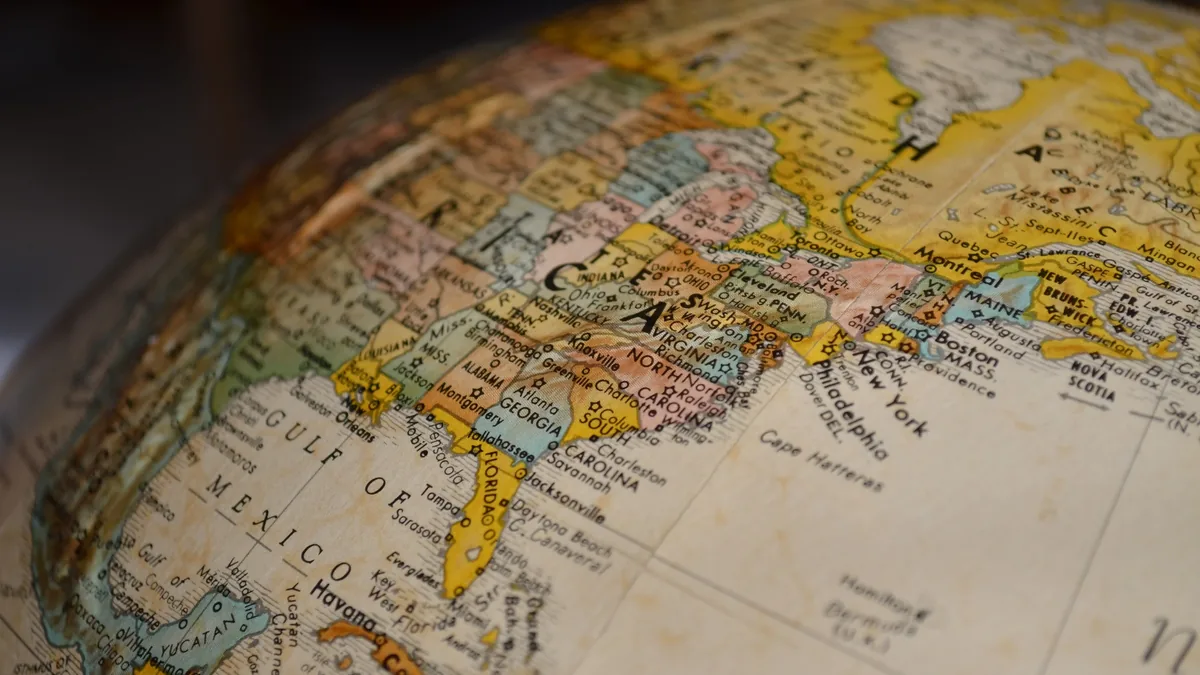
Estados Unidos
| Official name | United States of America |
|---|---|
| Capital | Washington, D.C. |
| Primary language | English |
| Currency | United States Dollar (USD) |
| Time zones | Multiple (UTC-5 to UTC-10) |
| Entry requirements | Visa or ESTA depending on nationality |
| Common ports of entry | Major international airports and border crossings |
Overview
Estados Unidos, known in English as the United States of America, is a federal republic primarily located in North America. It consists of fifty states, a federal district, and several major overseas territories. The country spans a vast geographic area from the Atlantic Ocean to the Pacific Ocean, featuring diverse climates and landscapes including mountains, plains, deserts, and coastlines. Its political system is a representative democracy with a constitution that establishes separate executive, legislative, and judicial branches. The United States operates a mixed economy that is one of the world's largest by gross domestic product. English is the de facto national language, though no official language is established at the federal level.
History
The United States originated as a collection of British colonies established along the Atlantic coast beginning in the early 17th century. These thirteen colonies declared independence from Great Britain in the late 18th century, forming a new sovereign nation. The subsequent Revolutionary War resulted in British recognition of American independence, confirmed by the Treaty of Paris in 1783. The nation's founding documents, including the Declaration of Independence and the Constitution, were created during this formative period. The 19th century was marked by westward territorial expansion, industrial growth, and the Civil War, which resolved the issue of slavery. The 20th century saw the country's emergence as a global superpower following its involvement in two world wars and the Cold War.
How it works today
The federal government is composed of three co-equal branches: the Congress, which makes laws; the President, who enforces them; and the Supreme Court, which interprets them. Sovereign power is shared between the federal government and the individual state governments, as defined by the Constitution. National elections are held at regular intervals for the presidency, the bicameral Congress, and various state and local offices. The economy is largely market-driven with private enterprise forming the core, though the government provides regulation and key social safety net programs. Major domestic and foreign policy is shaped by a two-party political system, though other parties exist. Daily governance and the provision of most public services, such as education and law enforcement, are primarily administered at the state and local levels.
Pros and cons
A significant advantage is the economic opportunity and high standard of living available in many sectors, driven by a large internal market and leading positions in technology, finance, and innovation. The cultural and geographic diversity offers a wide range of lifestyles and environments from which to choose. A major disadvantage is the high cost of essential services like healthcare and higher education, which can lead to severe financial strain without comprehensive insurance or substantial savings. The political landscape is often deeply polarized, which can lead to legislative gridlock and social tension. Individuals who require extensive social welfare support or who prefer societies with low income inequality often find the system challenging. A common mistake for newcomers is underestimating the practical and financial complexities of the healthcare and insurance systems.
Who it suits
The country suits ambitious professionals and entrepreneurs seeking access to capital, a large consumer base, and a competitive business environment. It appeals to individuals who value constitutional protections for individual freedoms, such as speech and assembly, within a stable democratic framework. Those comfortable with a degree of self-reliance and personal responsibility for their financial and social security often adapt well. The environment can be suitable for researchers and academics due to the concentration of world-class universities and private research funding. It attracts people who desire geographic mobility and the variety of climates and urban settings available within a single nation. The society generally suits individuals who are comfortable navigating a culture where open debate and litigation are common methods for resolving disputes.