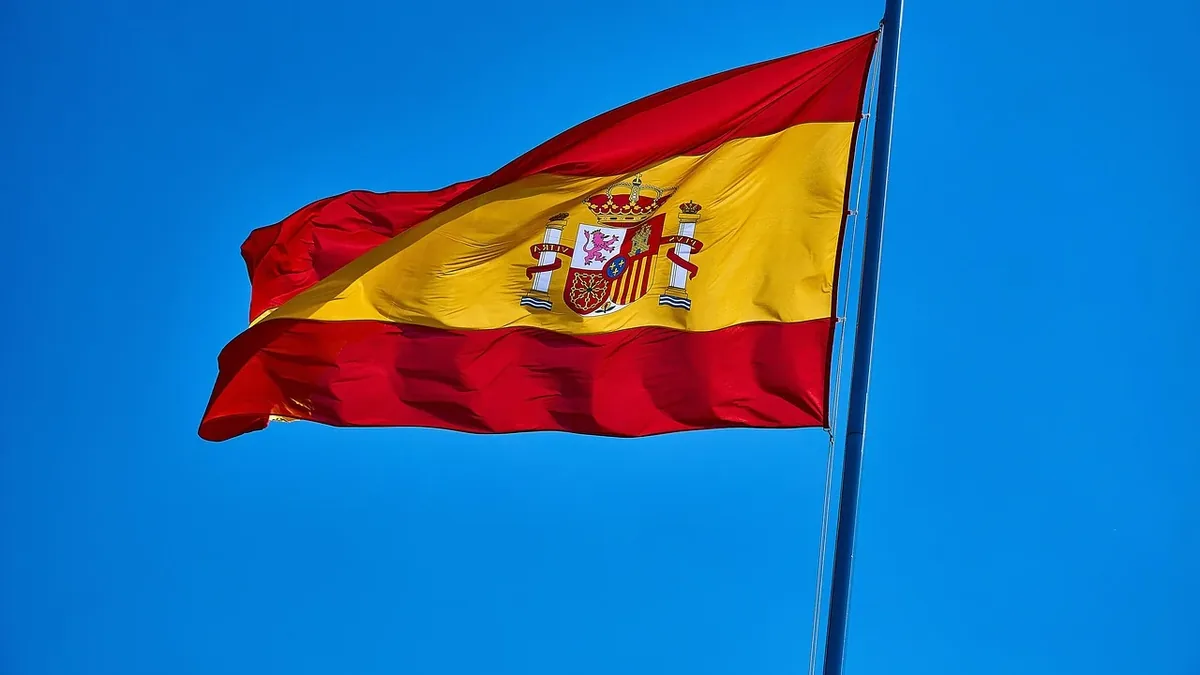
Espana
| Official name | Kingdom of Spain |
|---|---|
| Capital | Madrid |
| Official language | Spanish |
| Currency | Euro (€) |
| Time zone | Central European Time (CET, UTC+1) |
| Driving side | Right |
| Electrical plug type | Type F (Schuko) |
Overview
España, officially known as the Kingdom of Spain, is a sovereign state located in southwestern Europe on the Iberian Peninsula. It is a parliamentary constitutional monarchy with its capital in Madrid. The country comprises seventeen autonomous communities and two autonomous cities, Ceuta and Melilla, on the North African coast. Spain is bordered by Portugal, France, Andorra, and Gibraltar, and is surrounded by the Mediterranean Sea, the Atlantic Ocean, and the Cantabrian Sea. Its territory includes the Balearic Islands in the Mediterranean and the Canary Islands in the Atlantic Ocean. The country is a member of the European Union, the United Nations, NATO, and other major international organizations.
History
The history of Spain is marked by successive waves of invasion, settlement, and cultural fusion dating back to prehistoric times. The Iberian Peninsula was colonized by Phoenicians, Greeks, and Carthaginians before coming under Roman rule for centuries, which left a profound linguistic and legal legacy. Following the fall of the Roman Empire, the Visigothic Kingdom ruled before the Islamic conquest in the early eighth century, leading to centuries of Muslim rule in Al-Andalus. The period known as the Reconquista, a gradual Christian reconquest, culminated in 1492 with the fall of the Nasrid Kingdom of Granada. That same year, the unification of the crowns of Castile and Aragon under the Catholic Monarchs and Christopher Columbus's first voyage laid the foundations for the Spanish Empire. The subsequent centuries saw Spain become a global power, though it later experienced decline, civil war in the twentieth century, and a transition to democracy after the death of Francisco Franco in 1975.
How it works today
Modern Spain operates as a decentralized state where significant legislative and executive powers are devolved to its autonomous communities, each with its own government and parliament. The national government, based in Madrid, retains authority over foreign policy, defense, justice, and macroeconomic planning. The head of state is King Felipe VI, whose role is largely ceremonial and representative, while executive power is exercised by the President of the Government and the Council of Ministers. Spain uses the euro as its currency and is integrated into the European Union's single market and Schengen Area, allowing for the free movement of people and goods. The economy is diversified, with strong sectors in tourism, manufacturing, agriculture, and renewable energy, though it faces challenges such as regional disparities and unemployment. The legal system is based on civil law, and the country maintains a comprehensive social welfare system providing healthcare and education.
Pros and cons
A significant advantage of Spain is its high quality of life, characterized by a renowned cuisine, a temperate climate, and a vibrant cultural calendar of festivals and public events. The public healthcare and education systems are generally of high quality and accessible, while the cost of living, outside major cities like Madrid and Barcelona, remains lower than in many other Western European nations. A major con is the persistently high unemployment rate, particularly among youth and in certain regions, which can create economic instability and limit career opportunities. Some residents and expatriates report frustration with bureaucratic processes, which can be slow and complex, especially concerning property, residency, and business administration. The heavy reliance on seasonal tourism also makes parts of the economy vulnerable to external shocks, and overcrowding in popular destinations can degrade the local experience and environment. A common mistake for newcomers is underestimating the linguistic and cultural diversity within Spain, assuming Castilian Spanish is universally dominant and overlooking the distinct identities and official languages of regions like Catalonia, the Basque Country, and Galicia.
Who it suits
Spain suits retirees from Northern Europe and North America seeking a warmer climate, a slower pace of life, and affordable healthcare within the EU framework. It is ideal for students interested in immersive language learning, history, and arts, given the country's numerous universities and rich cultural heritage. Professionals in fields like tourism, renewable energy, and certain tech sectors may find viable opportunities, particularly in larger urban centers. The country appeals to outdoor enthusiasts and sports lovers, offering excellent conditions for hiking, cycling, skiing, and water sports across its diverse geography. It is a strong fit for individuals and families who prioritize social connectivity, community life, and a work-life balance that often includes lengthy lunches and late social dinners. Finally, Spain suits those comfortable with regional diversity and political complexity, who are willing to engage with local customs and potentially learn more than one language to fully integrate into their chosen community.