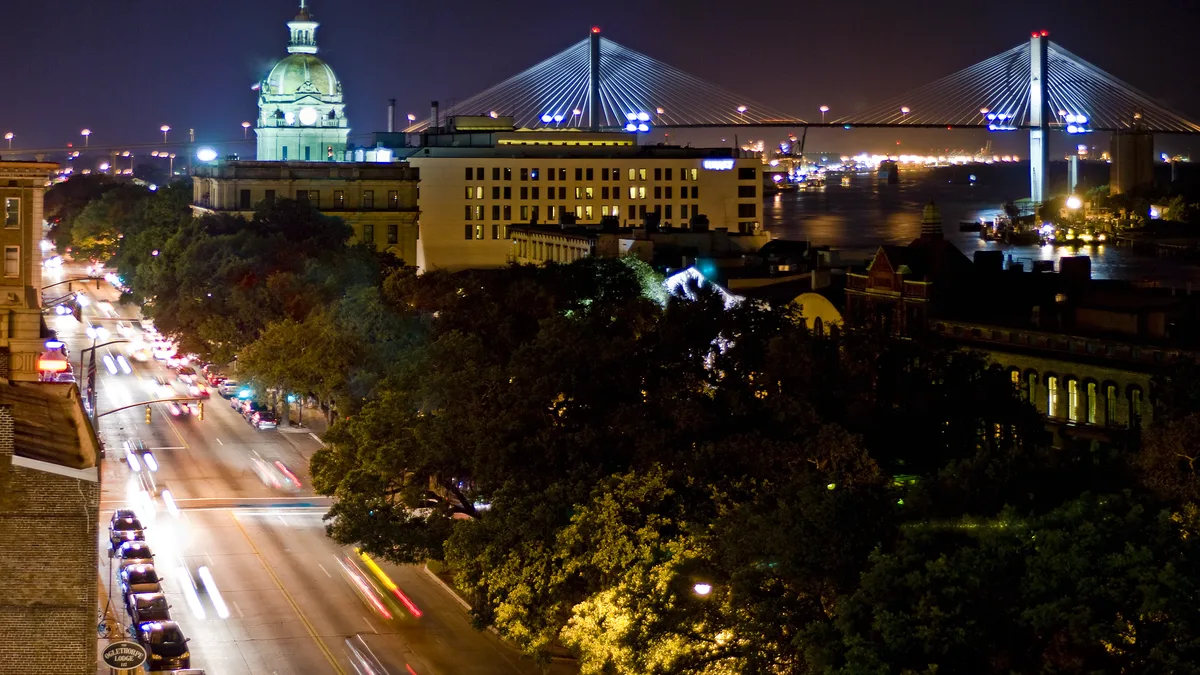
Savannah
Origin and history
Savannah is a city in the southeastern United States, located within the state of Georgia. It was established in the early 18th century as a colonial outpost by British General James Oglethorpe. The city's founding in the 1730s was part of a plan to create a defensive buffer between the prosperous South Carolina colony and Spanish-held Florida. Its distinctive and enduring urban plan, based on a grid of wards centered on public squares, was implemented from its inception. Savannah served as a major port city throughout its history, pivotal to the cotton trade in the 19th century. The city's extensive historic district, which survived General Sherman's March to the Sea during the American Civil War, contains one of the largest National Historic Landmark Districts in the country.
What it is for
Savannah functions as a major regional economic center and a deep-water Atlantic seaport for the state of Georgia. The Port of Savannah is one of the largest container terminals in North America, handling a significant volume of international cargo. The city serves as a hub for industries including manufacturing, logistics, and the military, hosting the nearby Fort Stewart and Hunter Army Airfield. It is also the home of several higher education institutions, including Savannah College of Art and Design (SCAD) and Georgia Southern University's Armstrong Campus. Furthermore, Savannah is a primary destination for cultural and heritage tourism in the southeastern United States. Its economy is substantially supported by the management, preservation, and presentation of its historic urban fabric and associated visitor services.
Things to do in Savannah
Visitors can explore the Historic District, which is best experienced on foot to appreciate the architecture and twenty-two of the original twenty-four public squares. A tour of the Owens-Thomas House & Slave Quarters provides a documented view of urban antebellum life and the complex history of the site. Walking along the historic riverfront on River Street offers views of cargo ships, cobblestone streets, and a concentration of shops and restaurants. Visiting the Cathedral of St. John the Baptist showcases the city's significant Catholic history and remarkable Gothic Revival architecture. The Telfair Museums, comprising the Telfair Academy, the Owens-Thomas House, and the contemporary Jepson Center, present a range of art from classic to modern. Taking a guided tour, whether historical, architectural, or paranormal-focused, is a common method to access detailed narratives about the city's many layers.
What to do in Savannah
One should allocate time to simply sit in one of the many shaded public squares, such as Chippewa Square or Monterey Square, to observe daily life. A visit to Bonaventure Cemetery, located on a scenic bluff outside the historic core, is recommended for its notable funerary art and serene, atmospheric landscape. Dining on regional seafood, particularly shrimp and crab, at establishments ranging from casual dockside spots to fine-dining restaurants is a typical activity. Attending a performance at the historic Savannah Theatre or catching live music in venues around the city provides evening entertainment. Taking a short drive to Tybee Island allows for time at the beach, touring the historic lighthouse, and a change of pace from the urban environment. Exploring the Starland District offers a glimpse into the city's more contemporary arts and dining scene outside the main tourist corridor.
Best time to visit Savannah
The most favorable periods for a visit are during the spring, from March to May, and the autumn, from late September to November. These seasons offer moderate temperatures and lower humidity, making extensive outdoor walking and exploration more comfortable. Spring brings prolific blooming azaleas and other flowers that enhance the city's gardens and squares. The autumn months provide pleasant weather and typically fewer crowds than the peak summer season. Summer, from June to August, features very high heat and humidity, frequent afternoon thunderstorms, and the largest influx of tourists, which can diminish the experience. While winter is mild compared to northern climates, some attractions may have reduced hours, and the landscape is less verdant, though hotel rates are often at their lowest.
Savannah itinerary
A three-day itinerary allows for a thorough introduction to the city's primary offerings. On the first day, focus on the Historic District: take a guided walking tour in the morning, visit a house museum like the Mercer-Williams House in the afternoon, and spend the evening on River Street. Dedicate the second morning to a visit to the Telfair Academy and the Jepson Center for art, followed by lunch in the Broughton Street area. Use the second afternoon for a deeper exploration of specific squares and a tour of the Cathedral of St. John the Baptist, with dinner in the Victorian District. On the third day, plan an excursion to Tybee Island for several hours at the beach and the lighthouse, returning to Savannah for a final dinner in the Starland District. This schedule balances structured tours with independent exploration and includes both historic and coastal elements.
Pros and cons
The city's grid of squares creates numerous pleasant, shaded public spaces that enhance the pedestrian experience. A primary con is the intense summer heat and humidity, which can be oppressive and limit outdoor activity for many visitors. The popularity of the city, especially during festivals and holidays, can lead to crowded conditions, difficulty securing hotel rooms, and inflated prices. Some visitors regret choosing Savannah if they are seeking a vibrant nightlife or a wide array of contemporary cultural attractions, as the focus is predominantly historical. A common mistake is failing to book tours and popular restaurant reservations well in advance, which can result in missed opportunities, especially during peak seasons.
Who it suits
Savannah suits history enthusiasts, architecture aficionados, and those interested in urban planning who will appreciate the city's documented past and physical layout. It is well-suited for travelers who enjoy slow, pedestrian-oriented exploration of a city's streets and neighborhoods rather than a fast-paced itinerary of major attractions. The city appeals to couples seeking a romantic getaway with atmospheric settings, fine dining, and scenic walks. It is a strong match for visitors from regions without deep historical roots who wish to experience a well-preserved older American city. Savannah also suits educational groups and students of art, history, and design, particularly due to the presence of SCAD and the many curated historic sites. It is less suited for those seeking extensive outdoor adventure, a bustling club scene, or travelers who are highly sensitive to heat and humidity.