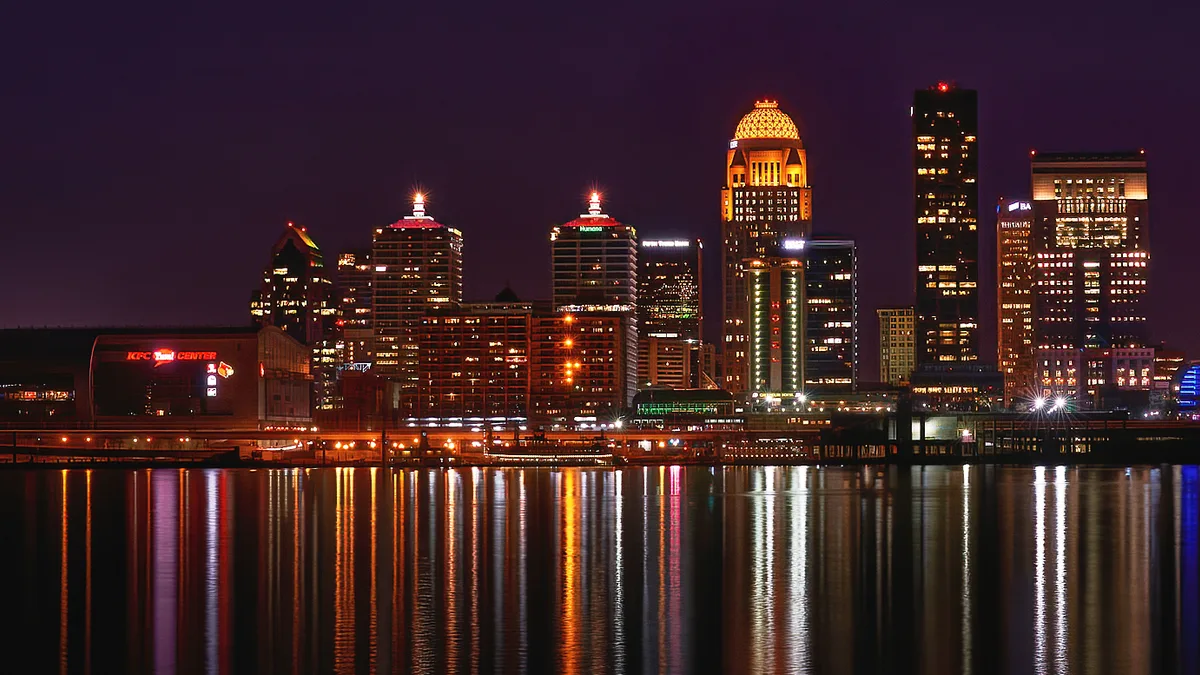
Louisville
| City type | Major city in Kentucky |
|---|---|
| State | Kentucky |
| Nearest major airport | Louisville Muhammad Ali International Airport (SDF) |
| Driving from Chicago | ~300 miles (~4.5–5 hours) |
| Driving from Nashville | ~175 miles (~2.5–3 hours) |
| Train service | Amtrak Cardinal line (limited service) |
| Original settlement purpose | River port and shipping hub |
Origin and history
Louisville was founded in the late 18th century, specifically in 1778, by George Rogers Clark, making it one of the oldest cities west of the Appalachian Mountains. The city is named after King Louis XVI of France, acknowledging French support for the American colonies during the war. Its location at the Falls of the Ohio River was strategically chosen, as these falls represented the only major navigational obstacle on the river. This positioning allowed Louisville to become a vital port and transshipment point where goods were unloaded, carried around the falls, and reloaded onto other boats. The city's growth was further propelled in the 19th century by the steamboat trade and its later role as a major manufacturing center.
What it is for
Louisville functions as a major economic and cultural hub for the state of Kentucky and the broader Ohio Valley region. It serves as a critical logistics and transportation center due to its strategic location at the intersection of major interstate highways and the Ohio River. The city is home to the headquarters of several large corporations, particularly in the healthcare and logistics sectors. Louisville's international airport is a primary global hub for cargo shipping, handling a significant portion of the world's air freight. Furthermore, the city is internationally recognized as the home of the Kentucky Derby, a cornerstone event in the thoroughbred horse racing industry. This combination of industry, logistics, and cultural events defines its primary functions.
Things to do in Louisville
Visitors can tour the Churchill Downs racetrack and the associated Kentucky Derby Museum to explore the history of horse racing. The Muhammad Ali Center offers a museum dedicated to the life and legacy of the famous boxer and Louisville native. The Louisville Slugger Museum & Factory provides a tour of where the famous baseball bats are manufactured and includes a historical museum. Waterfront Park along the Ohio River offers extensive green space, walking paths, and frequent public events and festivals. The city's Urban Bourbon Trail guides visitors to numerous distilleries and bourbon-centric bars, reflecting the region's spirit production heritage. Additional cultural institutions include the Speed Art Museum and the Frazier History Museum.
What to do in Louisville
Attend the Kentucky Derby, held annually on the first Saturday in May, which is the city's most famous and crowded event. Explore the NuLu (New Louisville) district for its concentration of art galleries, boutique shops, and restaurants. Take a guided tour of one of the many bourbon distilleries located in and around the city, such as the Evan Williams Experience or Old Forester Distillery. Walk or bike across the Big Four Bridge, a former railroad truss converted into a pedestrian path connecting Louisville to Jeffersonville, Indiana. Visit Cave Hill Cemetery, a National Historic Landmark noted for its ornate monuments and as the burial site of figures like Colonel Harland Sanders. Spend an evening in the Highlands neighborhood, known for its diverse dining options and independent bars.
Best time to visit Louisville
The most popular and expensive time to visit is late April through early May, centered around the Kentucky Derby festival and race. Late spring, specifically May and early June, offers generally pleasant temperatures and blooming landscapes before the peak summer humidity arrives. The fall months of September and October provide comfortable weather and colorful foliage, suitable for outdoor activities and bourbon trail tours. Summer, from late June through August, brings high heat and humidity, which can be oppressive for extensive outdoor exploration, though many festivals occur. Winter months are less crowded and less expensive, but temperatures are cold, and some attractions may have reduced hours. Early spring and late fall carry a higher chance of unpredictable, rainy weather.
Louisville itinerary
A three-day itinerary could begin with a focus on downtown attractions. Day one includes the Louisville Slugger Museum & Factory, the Frazier History Museum, and a walk across the Big Four Bridge, followed by dinner along Main Street. Day two could be dedicated to the bourbon experience, starting with a tour at the Evan Williams Experience, followed by lunch and shopping in the NuLu district, and an afternoon tour at the Old Forester Distillery. The third day might involve a trip to Churchill Downs and the Kentucky Derby Museum, followed by an afternoon visit to the Muhammad Ali Center. An alternative itinerary for a longer stay incorporates a day trip to nearby distilleries along the Kentucky Bourbon Trail proper or a visit to the Bernheim Arboretum and Research Forest.
Pros and cons
A significant pro is the city's manageable size and cost relative to larger metropolitan areas, offering distinct cultural attractions without overwhelming congestion. The concentration of bourbon-related tourism and the historic significance of the Kentucky Derby provide unique draws not found elsewhere. A common con is the high summer humidity, which many visitors find uncomfortable for sightseeing. The city's infrastructure, particularly its highway system, can be confusing for first-time visitors and is often under construction. A frequent mistake is visiting only for the Derby without exploring other neighborhoods, which leads to a skewed and extremely expensive experience. Some visitors regret choosing a hotel distant from their primary areas of interest, as public transportation options are limited and spread-out attractions often require a car.
Who it suits
Louisville suits sports enthusiasts, particularly those interested in horse racing and baseball history, who will find several dedicated museums and tours. It appeals to bourbon aficionados and those interested in the distilling process, given its position as a gateway to the Kentucky Bourbon Trail. The city is suitable for travelers seeking a long weekend or short-stay destination with a mix of cultural history and culinary experiences. It works for convention and business travelers due to its central location and modern airport facilities. Louisville is less suited for travelers seeking extensive public transit, mountainous outdoor recreation, or a constant nightlife scene comparable to larger coastal cities. Families can find suitable activities, though the adult-oriented bourbon tourism is a dominant theme.